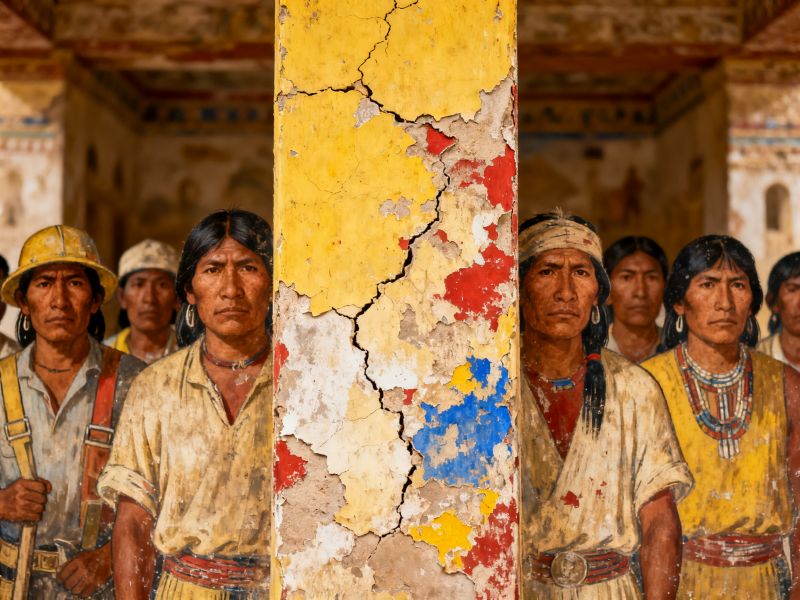
Diego Rivera reshaped public art with frescoes that turned walls into arguments. From the Ministry o
Diego Rivera never painted a single canvas that didn't argue with someone. That's the first thing to understand about the man whose name became a synonym for public art in the Americas. In 1922, he returned to Mexico from Europe carrying a suitcase of cubist experiments and a head full of Marxist theory. Within a year, he was standing on scaffolding inside the Ministry of Public Education, painting 124 frescoes that made bureaucrats uncomfortable and students late for class. The Rivera who emerged from those walls wasn't a decorator. He was a prosecutor with a brush.What made Rivera's work stick wasn't scale. Plenty of artists can fill a wall. His genius was compositional violence—forcing factory workers, indigenous women, and Zapatista soldiers into the same visual frame as pre-Columbian gods and Henry Ford. You can see it at the Detroit Institute of Arts, where his 1932 fresco cycle treats the assembly line like a religious altar. The museum's trustees nearly fired him for including a vaccine vial and a fetus in the same panel. Rivera didn't blink. He told them the fresco would stay or he'd repaint it in their lobby with their own faces as capitalist ghouls. They kept it.That stubbornness cost him. Nelson Rockefeller commissioned a mural for Rockefeller Center in 1933 and then ordered it destroyed when Rivera slipped a portrait of Lenin into the composition. The loss was real—we only have black-and-white photographs of that work. But Rivera's response revealed something more interesting than martyrdom. He repainted the same theme in Mexico City's Palacio de Bellas Artes, added a caricature of Rockefeller himself, and titled the new piece Man at the Crossroads. The original was Man at the Crossroads Looking with Hope and High Vision to the Choosing of a New and Better Future. He turned a commission into a grudge match and won the long game. Rivera understood that public art is never just about the wall. It's about who controls the story after the paint dries.Critics love to reduce Rivera to a political propagandist. That's lazy. Look at his 1947 painting Nude with Calla Lilies—the flesh tones are almost tender, the line work almost hesitant. He could be gentle. He could also be petty, unfaithful。and cruel to his partners, including Frida Kahlo, whose own work he dismissed for years before acknowledging she was the better painter. Rivera's personal life was a train wreck he kept driving. That contradiction is the point. A Rivera fresco doesn't resolve tension. It holds it up to the light and says: deal with this.Today, his murals in Mexico City still draw crowds, but the Rivera that matters is less visible. Every time a city council argues over a public monument, every time a muralist sneaks a political message into a commission, every time an artist refuses to separate aesthetics from economics—that's Rivera's ghost. He didn't invent political art. He made it impossible to ignore. And if you stand in front of his Epic of the Mexican People at the National Palace, you'll notice something odd. The faces closest to the ground。the ones holding tools and baskets—they look straight back at you. That's not metaphor. Rivera painted them to stare. He wanted you to feel the weight of being watched by the people you usually walk past. Not comfortable. Not meant to be.